
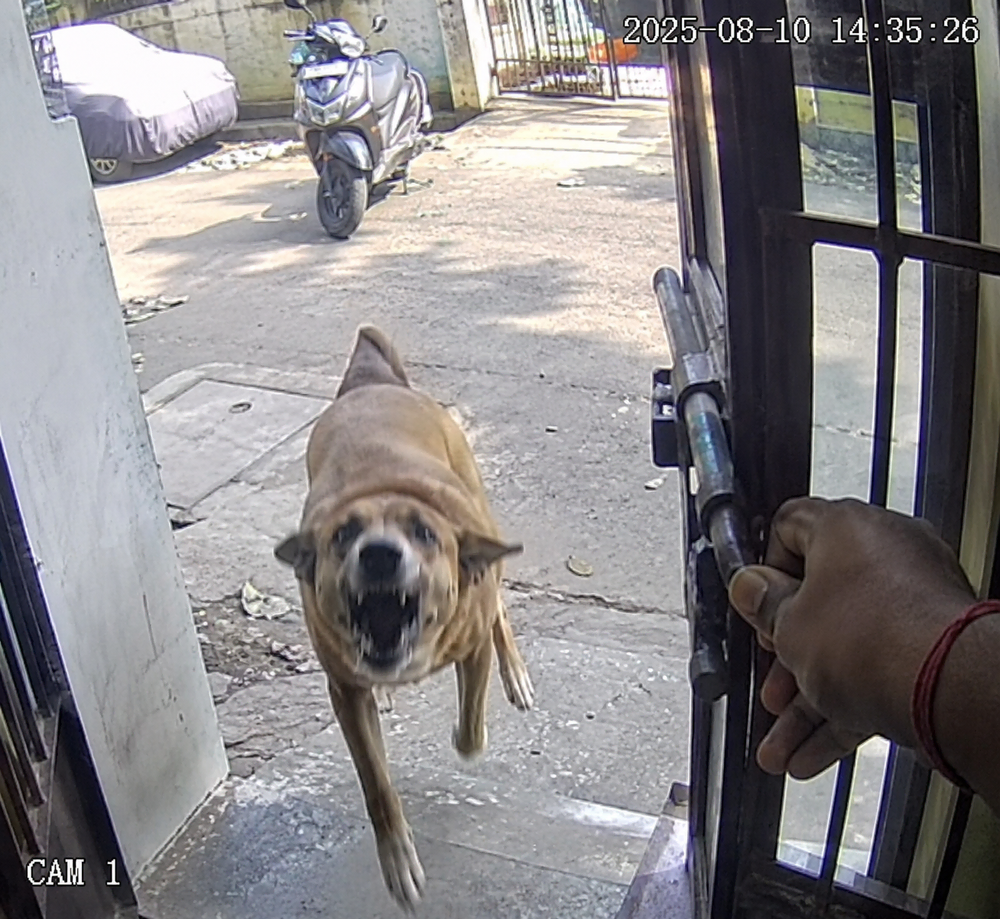
A video did the rounds recently from Chandigarh. A few people arrive at the gate of a house that's up for rent, standing on the street the way anyone does when they've come to look at a place. From inside, an uncle walks up and opens the gate. A dog comes through it — nobody called it, nobody sent it, no command given — and goes straight at the strangers at its threshold.
Watch it once and you watch the dog. Watch it twice and you stop looking at the dog entirely. You look at the hand on the latch.
Because the dog did not open the gate. It could not. It has no thumbs, no plan, no concept of "rented house" or "prospective tenant." It had exactly one piece of information available to it — unknown people, at my threshold — and it did the one thing that thousands of years of being bred to sit at our thresholds trained it to do. A human opened the gate. The dog walked through the hole a human made.
We have been here before. A cow cannot untie the bag. A dog cannot open the gate. Different animal, identical machinery underneath: the human makes the decision, and the animal is handed the blame for it.
01Pick a lane
Here is the contradiction I am genuinely tired of, and it runs through nearly every conversation Indians have about animals. When it is convenient, we say animals understand nothing. They can't reason. They don't really think — which is how we justify skipping the training, skipping the sterilisation, skipping every ounce of effort their care would demand.
And then the same animal does something that doesn't suit us, and in the space of a single second we promote it to a moral criminal. Now it is vicious. Now it chose this, and it must be punished, removed, bred out of existence. Now, apparently, it had all the agency in the world.
You cannot have it both ways. Moral blame requires a mind capable of choosing wrong. If the dog is clever enough to be guilty, it is clever enough to have an inner life you were obligated to respect all along. And if it is not that kind of agent, then it did not commit a crime at the gate — it completed a reflex, and the author of that reflex was the person who bred it, raised it, and opened the latch.
Every road out of this leads back to the same place: the human hand.
02The Sunday morning problem
Be honest about what we actually do with a dog's ferocity, because we don't just tolerate it — we harvest it. You know the lazy Sunday where a fly buzzes against the bathroom wall and the dog goes rigid, and you don't calm him — you egg him on. Get it. Go on. You laugh. The bark at the courier, the lunge at the monkey, the growl at the man too close to the gate — half the time we don't correct these, we reward them.
Then a stranger appears at the gate we told him to guard, and we are shocked he cannot tell our sanctioned ferocity from the unsanctioned kind. But we never drew that line for him. We can't even draw it consistently for ourselves: bark at the delivery boy is funny, bite the delivery boy is a crime, and the only creature expected to know the precise difference is the one we've decided is too stupid to understand anything.

03What the science actually says
If you want to blame the breed, the evidence has quietly pulled the floor out from under you. The largest study of its kind, published in Science in 2022, found that breed explains less than 10 percent of the behavioural variation between individual dogs. For many traits, a dog's age or sex predicts its behaviour better than its breed. And there was no behaviour exclusive to any one breed.
What does predict aggression is the part we'd rather not look at:
- Fear, and a lack of early socialisation.
- Being left intact rather than neutered.
- Isolation, and a first-time owner out of their depth.
- Punishment itself — which reliably makes a reactive dog worse.
Every one of those is a human input. So "it's the breed" isn't only morally lazy — it is empirically wrong. It survives because it locates the danger inside the animal, where fixing it costs us nothing, instead of inside our own conduct, where fixing it would cost us effort.
04Punishing the animal is a national policy
In March 2024, India's Department of Animal Husbandry told states to stop breeding and selling 23 breeds it declared "ferocious and dangerous." Existing pets were to be sterilised so the line would end with them. It collapsed almost immediately — the Karnataka and Delhi High Courts struck the circular down, and the courts pointed away from breed and toward responsible ownership as the actual answer.
Then, in August 2025, the Supreme Court ordered that roughly a million stray dogs across Delhi-NCR be rounded up and, at first, never released. The trigger was the rabies death of a child. The grief was real. But the reflex was the same — reach for the animal, because the animal is the thing you can seize, while the causes that produced it require us to change, and changing is harder than catching.
05So — can they regulate their emotions or not?
If your answer is no — a dog cannot modulate what it feels — then the animal at the gate is not a villain. There was no test. There was only a reflex we installed and a latch we lifted. The blame is ours.
But if your answer is yes — you genuinely believe a dog can learn to sit at a threshold and let a stranger pass — then understand what you've admitted. Self-control in a domesticated animal is not a factory setting. It is the finished product of years of human labour. So please, actually domesticate them. You do not get to demand the output of domestication while skipping every hour of its process, then act betrayed and reach for a ban.
Either they can't regulate, and it was never their fault — or they can, and it was your job to teach them, and you didn't. There is no third door where the dog is guilty and you are innocent.
06Back at the gate
Play the clip one more time and hold your eyes on the latch. The uncle walks up. His hand closes on the metal. He lifts it. The gap opens. The dog — loyal, doing precisely the job we've bred dogs to do for ten thousand years — goes through the gap that a human, with a plan and a thumb and a choice, decided to make.
Ask who the problem is. Not to be cruel about the uncle; he is every one of us who ever wanted the guard without the guardianship. Ask it because the answer is the only thing that will ever make anyone safer. Not the breed. Not the dog. The hand on the gate.