
Issue 03 · 29 Aug 2026
The Donkey Collapse
← all issues

Issue03

Hi, creatures. This one is about the animals we built into the economy and then modernised out from under — and why the word stray is doing so much work. Plus an eleven-panel comic, a dog on homemade wheels, two findings, and what's stirring on the roads.

01The Focus

The case

The Donkey Collapse

The machine took the job. It has never once taken the animal. An argument for retirement, not rescue.

Three donkeys grazing on a rubbish-strewn verge beside the highway at the entrance to Manali
Photo · credit
The verge outside Manali. Nobody's animals, standing exactly where somebody's animals were left.

Drive into almost any hill town in India and you meet them before you meet the town. A horse with its ribs counting themselves. A donkey standing in that specific way animals stand when nobody is coming for them. Somebody made a living off that animal once. Somebody is very much not making a living off it now.

The animal didn't change. Its use did. We value animals for what they're currently doing for us, and we issue that value on loan — payable in work, or milk, or cuteness — reserving the right to call the loan the instant the payments stop.

It isn't a tragedy of nature. It's a repossession.

In 1992 India had roughly 967,000 donkeys. By the 2019 census, about 120,000. Machines took the work, and where that's all it means, take the win — nobody should haul a kiln's output on their spine because we hadn't invented the engine yet. But the machine is fussy about where it goes, and it only ever takes the job. It has never once taken the animal.

Then, in winter, the rope comes off and we call it freedom. Then the paperwork renames the animal a stray — a word that tells you where it is, instead of what happened to it, because the honest word has a person in it.

Read the full case →
02The Comic

Eleven panels, two receipts, one donkey who was never told about the clause. Filed under contracts signed by one party:

A comic strip · read it before the upgrade

Nobody Retires a Donkey

A comic about a donkey, a truck, and a bill left on the verge.

Filed under: contracts signed by one party

01

Meet the donkey. Job title: carry the thing. He has held this position for five thousand years. Never late. Never unionised. Never once asked what happens at the end.

02 SPEC SHEET · DONKEY v.10,000 WILD INSTINCT .... REMOVED (ON PURPOSE) NEEDS HUMAN ...... YES. PERMANENTLY. ABILITY TO QUIT .. NONE SHIPPED AS DESIGNED

He didn't wander into this. We built him for it — bred the wild out on purpose, over ten thousand years, to spec. The dependence isn't a phase he'll grow out of. It's the finished product.

03 BRRRM

Then: the truck. And honestly? Good. Nobody should carry a kiln's daily output on their spine because we hadn't got round to inventing the engine. progress can take the job with my blessing.

04 JOB

The machine is fussy about where it goes — mules still hold on in the hills a truck can't climb. But wherever it reaches, it takes the job. It takes the job. It has never once taken the animal.

The number nobody wants on a mug

India had roughly 967,000 donkeys in 1992. By the 2019 livestock census: about 120,000 — nearly nine in ten gone in twenty-seven years. Between 2012 and 2019 alone, donkeys fell 61%, mules 57%, horses and ponies 45%. The whole working-equine family halved, 1.14 million to 550,000, in the time it takes a kid to finish primary school.

05 SEVERANCE PACKAGE ( empty )

No notice period. No pension. No exit interview. He wasn't fired — firing at least involves paperwork. The work simply stopped, and he was still standing there when it did.

06 OWED carried forward →

Before you hunt for a villain with a stick: in one brick-kiln study, every single donkey owner was in debt bondage. The animal that's indispensable in October is a mouth you can't feed in January. the donkey's body was the owner's balance sheet, kept in flesh.

07 FREE!* ?

So when winter comes and the work dries up but the fodder doesn't, the rope comes off. We call this setting him free. *he was never wild — we removed that, remember. this is pulling out someone's insulin and calling it independence.

08 ABANDONED STRAY (person: removed)

Watch the trick. "Stray" tells you where an animal is. "Abandoned" tells you what happened to it. Guess which one we reach for. a stray is weather. an abandoned animal is an accusation with an address.

The paperwork, briefly

India's Animal Birth Control Rules, 2023 define "community dogs" to include abandoned pedigreed dogs. Your dog in the morning; a community dog by evening; the responsibility slides quietly off the owner and onto the local body. In Chennai this August, shelters logged more than 50 pedigree dogs dumped in ten days. Nothing about the animal changed. We changed the noun.

09 DONKEYS 1992 ...... 967,000 DONKEYS 2019 ...... 120,000 RETIRED PER YEAR .. ABANDONED ......... YEARS LIVED AFTER . STILL ON THE VERGE ✓✓ —— —— ↑ everything above this line still earns

The census can tell you the donkeys are down 88% since 1992, district by district. Ask how many working animals are retired each year, or abandoned, or how long a retired horse lives, and you get a blank column. First less useful. Then less visible. Then uncounted. the invisibility is the neglect, wearing a lab coat.

10 … 21,324 SCREENED · 423 UNFIT FULL a few dozen beds

Kedarnath, 2023: 21,324 equines screened, 423 flagged unfit to work — against an infirmary with a few dozen beds. A rescue answers where does he sleep tonight. Retirement answers who is responsible for the rest of his life. we have built a little of the first and almost none of the second.

11 CARE EXPIRES WITH THE INVOICE he never read this ↓

He did the work. He never read the contract — that the care was conditional, that "family" had a clause, that the value was issued on loan and could be called in. We wrote that clause. We're the only literate party in the deal. So the field at the end isn't charity; it's the rest of the invoice. Retirement, not rescue. and no, he can't hold us to it. no thumbs. we checked in issue one.
The machine replaced the work. It did not replace the responsibility.
Open the comic full-size →
03A Good Moment

Because it can't all be repossession. Two people who did the unglamorous half of the job — the half that starts after the animal stops being useful to anybody.

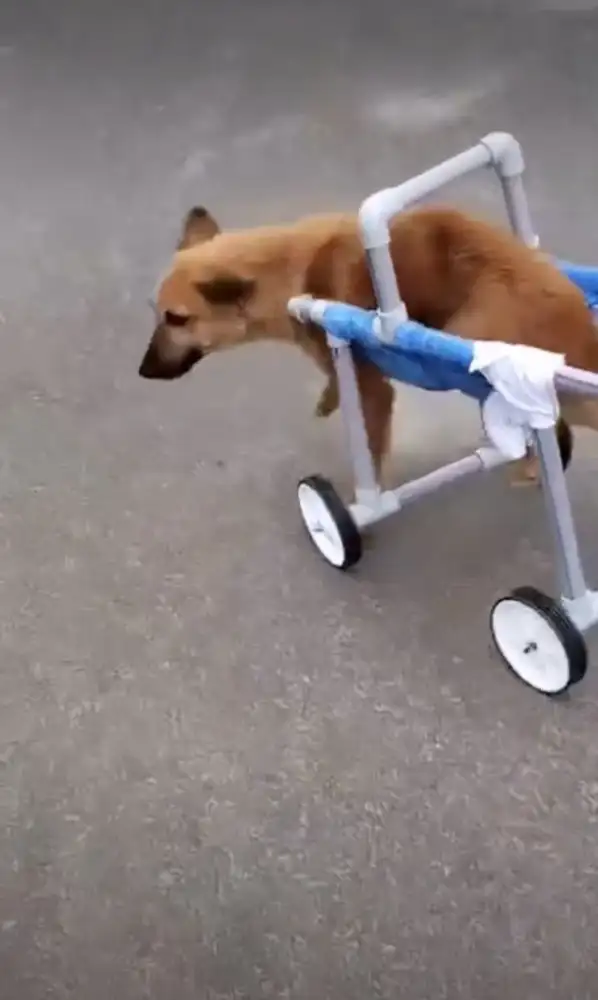
A dog lost the use of his back legs. No cart to order, no fund to apply to, no shelter to hand him over to. So somebody built him one — PVC pipe, two small wheels, a padded sling, cut and adjusted by eye until he could push himself down the road again. It is crooked. It works. And somewhere in the making of it, a street full of people quietly answered the question this issue is about: he was staying. A rescue is a night. This is the rest of his life, assembled out of hardware-shop parts.

Watch · Instagram →

And a shoutout to Ben's Dog Walking Club in Pasig — dog-psychology-based training, run out of the Philippines, whose tagline we'd have stolen outright if we'd got there first: training humans, not dogs. That is, more or less, the entire editorial position of this newsletter, except somebody turned it into a business and does it every day with six leashes in hand.

Follow · @bensdogwalkingclub →
04From the Science

Two findings that make it's just an animal harder to say out loud.

Neuroscience · affect

Seven emotions, wired in under the thinking part

Jaak Panksepp spent a career stimulating, lesioning and dosing mammalian brains and came out with seven primary emotional systems — SEEKING, RAGE, FEAR, LUST, CARE, PANIC/GRIEF and PLAY — sitting in the subcortex, the old shared machinery. Not learned behaviour. Architecture. His most-quoted result: rats chirp at 50 kHz when they play or get tickled, and prefer the company of rats that chirp a lot. Welfare science now builds to this spec — enrichment designed to run SEEKING and PLAY, husbandry designed to stop tripping PANIC/GRIEF, which is exactly what early separation from a mother does.

A donkey turned out for the winter isn't puzzled. It's running PANIC/GRIEF on hardware you're also running.

Source · Frontiers in Psychology / PMC →
Cognition · culture

Washoe taught her son to sign. Nobody asked her to.

Washoe was the first non-human to pick up American Sign Language. The finding that actually matters came a decade later: her adopted son Loulis learned signs from her while the researchers deliberately restricted their own signing around him to a handful of words — culture moving between two animals with no human in the loop. Then Kanzi, a bonobo, skipped the lessons altogether and acquired lexigrams by watching researchers work with his mother Matata, who was the one enrolled. Whether any of it counts as grammar is still argued over. That it was passed on, and picked up unasked, isn't.

Source · Smithsonian →
05City Notes

What's stirring on the streets near you. Small items, real places — send yours in and we'll run them.

India · retail

Nobody has gone first yet

Try walking a leashed, vaccinated dog into a Zudio. Or into most of India's mass-market chains, which don't have a pet policy at all — and no policy functions as no. Meanwhile the places that do welcome dogs are the ones charging ₹600 for a flat white. Pet-friendly has quietly become a luxury tier. The first national chain to publish a real policy — leashed, vaccinated, nowhere near the food aisles — takes a generation of customers off everyone else, and gets a whole item in this newsletter. The space is open. — swap if you have the Zudio announcement

Kutta · Tholpetty · Wayanad road

The tank outside the last shop before the forest

On the crossing where Coorg runs into Nagarhole and then into Wayanad — Kutta, Tholpetty, the thinning line of shops before the road goes quiet — people leave water out. Cement tanks, cut drums, an old sink by a gate, topped up for whoever turns up: travellers, cattle, dogs, whatever comes down off the ridge. Nobody funds it. Nobody counts it. It is the cheapest infrastructure in the country, and it does the one thing no census in this issue managed — it assumes something will be thirsty, and plans for it anyway.

Your city

Send us the good, the grim, and the local

A water tank on a forest road, a retired cart horse nobody knows what to do with, a shop that lets dogs in, a black-spot where the accidents keep happening. City Notes runs on tip-offs — reply to this issue with what you're seeing, and photograph it if you can.

So — are we doing right by them?

Mull it over · India · 2026 · Read about us · Privacy Policy