
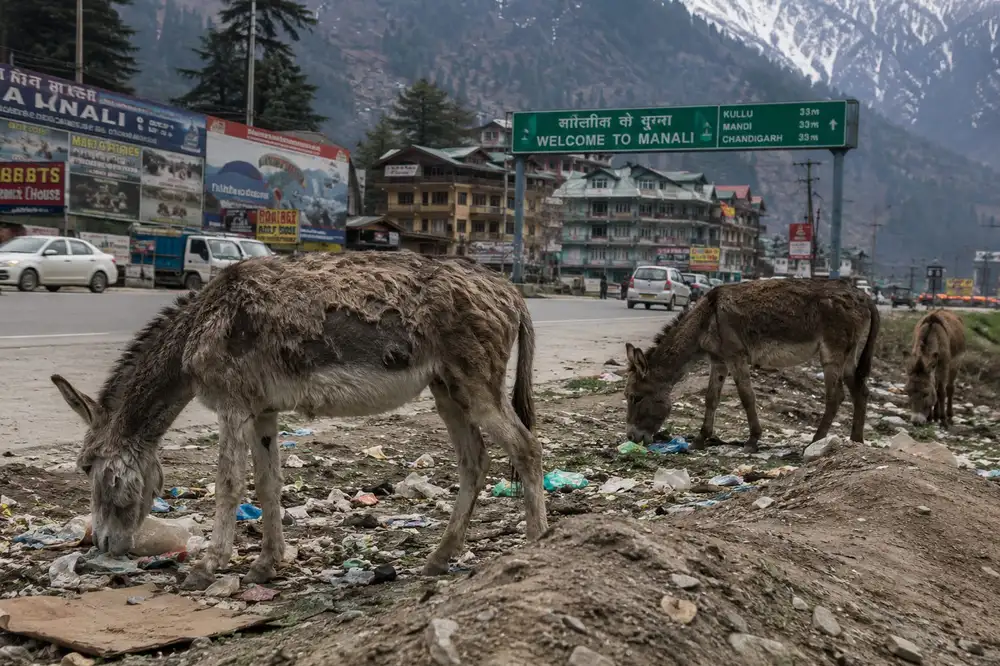
Drive into almost any hill town in India and you meet them before you meet the town. On the verge, where the good road gives out — a horse with its ribs counting themselves, a donkey standing in that specific way animals stand when nobody is coming for them. Not startled by the traffic, because traffic has stopped being interesting. Grazing the median, or a drift of chip packets. This is a tourist country. Somebody made a living off that animal once. Somebody is very much not making a living off it now.
The animal didn't change. Its use did. We like to think we value animals for what they are. Reality says otherwise: we value them for what they are currently doing for us. That value is issued on loan, payable in work, or milk, or cuteness — and we reserve the right to call the loan the instant the payments stop.
The horse on the verge isn't a tragedy of nature. It's a repossession.
India's donkeys have nearly vanished in a single generation. Machines took the work — but the work was never the whole contract. So what do we owe an animal once it stops earning for us, and why does it stop being ours the second we rename it a stray?
01The number nobody wants on a mug
Start with the donkey, because the donkey is where the arithmetic stops being polite. In 1992, India had roughly 967,000 donkeys. By the 2019 livestock census, about 120,000. Nearly nine of every ten, gone in twenty-seven years. And the floor fell out late: between 2012 and 2019 alone, the donkey population dropped 61 percent. Over the same seven years mules fell 57 percent, horses and ponies 45 percent. Put the whole working-equine family on one line and it goes from about 1.14 million animals to 550,000 — halved in the time it takes a child to finish primary school.
Some of this is nobody's tragedy, and it's worth saying so plainly, because the sentimental version of this story is a lie. Trucks replaced carts. Tractors replaced draught animals. A donkey is a slow, expensive, suffering way to move bricks the moment you can hire a tempo, and no creature should have to haul a kiln's daily output on its spine because we hadn't yet invented the wheel with an engine attached. Where the decline just means we found a faster machine, that's a sentence with a happy ending. Fewer animals foundering under loads is a win. Take the win.
But notice the machine's manners. It is fussy about where it goes. Mules are holding on in the Himalayan states — around 20,000 in Himachal, 26,000 in Uttarakhand — precisely because that's terrain a truck can't climb, while in the flatlands of Uttar Pradesh the mule population fell almost 79 percent. The machine takes the job wherever the machine can reach. It takes the job. It has never once taken the animal.
The machine replaced the work. It did not replace the responsibility.
02What were they supposed to do?
Here is where I want to be careful, because the easy story blames a poor man with a stick, and the easy story is usually wrong.
A study of donkeys working the brick kilns of Gujarat found every single owner interviewed was living in debt bondage. The animals carried the proof of it on their bodies: 49 percent with overgrown hooves, 28 percent with hooves chipped or cracked, 98 percent scarred, swollen, scabbed or losing hair — and among those, 42 percent with open wounds. The researchers put it cleanly. The condition of the donkey tracked the condition of the human who owned it. The animal's body was the owner's balance sheet, kept in flesh.
It is very easy to look at a foundered donkey and see a cruel man. The economics are less flattering and much less tidy. A healthy animal costs money. Seasonal, bonded, badly paid work does not reliably produce money. The same donkey that is indispensable in October is a mouth you cannot feed in January. In Kashmir, owners turn their donkeys loose for the winter when the work dries up and the fodder doesn't — not because they stopped caring, but because caring quietly acquired a price they couldn't clear. Poverty can make an animal disposable without the person ever once feeling like they did a cruel thing. The outcome is identical to cruelty. Only the paperwork of intention is different.
So no, this isn't a piece about villains. It's a piece about a country that built an entire class of animal into its economy, then modernised out from under it, and left the bill on the doorstep of the people least able to pay it — who then left it on the animal.
03We didn't set them free. We stopped.
The comforting word for turning an animal loose is freedom. Don't reach for it. A horse fed, shod and handled by people for years does not remember how to be a wild horse, because it was never a wild horse. We bred the wild out on purpose; that was the whole project. A donkey kept for carrying cannot become a self-sufficient donkey the day the carrying ends. The dependence isn't a phase they'll grow out of. It's the finished product. We manufactured it, to spec, over ten thousand years.
Which means letting the animal go is not freedom, and it isn't even, technically, abandonment. It's the withdrawal of a care we installed and then discontinued — like tearing out someone's insulin and calling it independence.
Worldwide Veterinary Service watched this play out in Ooty, where the collapse of pandemic tourism left an estimated 350 horses and ponies loose in the town. Some were ex-racehorses on their second career as tourist rides; microchips were the only way rescuers could reconstruct who they'd once belonged to. They foraged roadside rubbish, took traumatic injuries, went down under night traffic that never saw them. A racehorse becomes a tourist horse becomes a street horse becomes a colic case becomes a statistic, and at no point in that sentence did the horse do anything except keep being a horse.
04The law already knows the word
To its genuine credit, Indian law saw this coming sixty-five years ago. The Prevention of Cruelty to Animals Act, 1960, puts a plain duty on anyone in charge of an animal — food, water, shelter — and calls it cruelty to abandon an animal in conditions likely to starve it, or to put an old, sick, wounded or infirm animal to work. The Animal Welfare Board of India is even tasked, in actual statutory writing, with encouraging shelters for animals that have become old and useless.
Useless. The law says the quiet part out loud. A statute from 1960 named the exact moment this entire story turns on — the moment the animal stops earning — and then, having named it, mostly wandered off. Naming a problem and funding one are handled by different departments, and only one of them shows up.
05A rescue is not a retirement
There are people doing the unglamorous version of caring, and they are running out of room. Animal Rahat has pulled hundreds of donkeys out of mechanised brick kilns and horses out of cart work into lifelong sanctuaries; it built a second equine refuge specifically because the first one filled up. People for Animals Uttarakhand keeps a permanent home for a few hundred rescued animals, cycling through two or three new equines a month. On the Kedarnath pilgrimage route, a dedicated infirmary can hold a few dozen animals — against a season in 2023 that screened 21,324 equines and flagged 423 as unfit to work. Tens of thousands processed. Dozens of beds.
That gap is the whole problem in one ratio, so sit with it. A rescue answers the question where does this animal go tonight? Retirement answers who is responsible for the rest of its life? We have built a little of the first and almost none of the second.
And then Brooke India — an organisation whose entire model was working-equine welfare, not through rescue but by propping up the humans who depended on the animals — shut down operations on 1 April 2026, citing regulatory restrictions that severed its funding. Before it closed it was reaching, by its own count, around 179,639 working equines and 71,934 owners across eleven states. Those relationships didn't get retired. They got orphaned.
06The pets who were never working animals at all
Now walk this off the hills and into the city, where the same machine runs faster and looks nothing like a truck.
In Chennai this August, shelters reported more than 50 pedigree dogs dumped on roadsides or outside their gates in ten days — pugs, Great Danes, animals bred so far from survival they can barely manage a flight of stairs, let alone a street. In June, civic officials traced a Labrador, mangy and with maggots, back to its owner through its microchip, and talked about a fifty-thousand-rupee penalty. Around 79,000 pets in the city have now been chipped. A microchip can't make a person care. It can only make it harder to pretend nobody is responsible — which, it turns out, is as far as this game goes today.
The abandonment here isn't a fringe event; it's a pipeline. The 2021 State of Pet Homelessness Index — a model, not a census, so hold it loosely — put India at roughly 80 million homeless cats and dogs, 62 million dogs and 9 million cats on the street, and scored the country 2.4 out of 10. Its most damning figure wasn't a population count. It was a confession: 50 percent of Indian pet owners surveyed said they'd given up a pet at some point, against 28 percent globally; 34 percent said they'd left a dog on the street, 32 percent a cat. Shelter staff put the consequence in one flat sentence — nobody wants abandoned dogs — because the adoption culture that would catch them barely exists.
Here's the part that should genuinely unsettle you. When a pedigree dog gets dumped, India's 2023 Animal Birth Control Rules have a category ready for it. Community dogs, the rules say, include abandoned pedigreed dogs. The instant the animal hits the street, the paperwork reclassifies it: your dog this morning, a community dog by evening, and the responsibility slides quietly off the owner and onto the local body. The dog is genetically, behaviourally, emotionally the exact animal that slept on someone's bed yesterday. Nothing about it changed. We changed the noun.
07"Stray" is doing a lot of work
That's the trick this whole issue turns on, so let me say it as plainly as I can. Stray tells you where an animal is. Abandoned tells you what happened to it. We reach for the first word because the second one has a person in it.
A dog born on a street is a stray. A cat that never had a door is a stray. Fine. But a horse that carried tourists for six years is not stray when the tourists stop coming — it's abandoned. A donkey turned out because winter came but the work didn't isn't stray — it's abandoned. Stray launders the sentence. It removes the hand that opened the gate. And we do it on purpose, because a stray is a fact of the landscape, like weather, and an abandoned animal is an accusation with an address.
A stray is weather. An abandoned animal is an accusation with an address.
Notice what the state is actually good at, and what it isn't. It knows how to register a pilgrimage horse, tag it, certify its health, license a pet, sterilise a street dog, monitor an ABC centre. It is fluent in the animal while the animal is economically legible — while it's working, earning, or at least traceable. The livestock census can tell you the donkey population fell 88 percent since 1992, to the state, to the district. What no census, no ministry, no dataset in this country can tell you with any confidence is:
- How many working animals are retired each year.
- How many are abandoned.
- How many enter sanctuaries — or how long a retired equine lives once it does.
- How many are standing on a verge outside a hill town right now.
Even Ooty, where the horses have been a visible problem for years, doesn't have a current public count. That isn't a gap in the reporting. That is the reporting. First the animal becomes less useful. Then it becomes less visible. Then we stop counting — because it isn't protesting, isn't voting, and isn't inconveniencing anyone by any act of its own. Weak, and therefore ignorable. The invisibility is the neglect, wearing a lab coat.
08Street pets
Which is why I can't shake the phrase, ridiculous as it sounds. Street pets.
Stray asks nothing of you. But a pet asks you to imagine a before. A home. A name. A hand that used to reach for them, that knew when they were hungry and where they slept. Not every animal on the street had that life — of course not. But enough of them did that the word stray, applied to all of them, is a small daily act of forgetting.
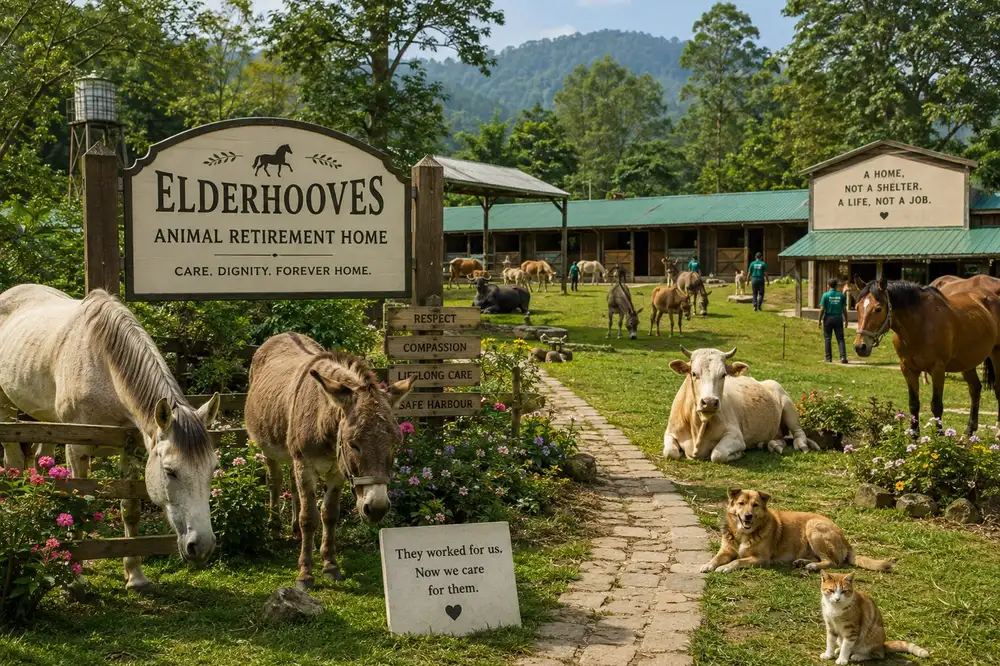
Change the noun and you change the question. Stop asking why this animal is on the street — a question with no one in it — and ask what happened to the person who was supposed to care for it. And then the hard one, the one this whole collapse is really about: when exactly did we decide our obligation to an animal ends the moment its usefulness does?
Because we wrote that contract. Not them. The donkey did its work. The horse did its work. The dog learned its name and the cat learned its door, and not one of them ever understood the terms — that the care was conditional, that it expired with the invoice, that family had a clause. We understood. We wrote the clause. We're the only literate party in the deal.
There are fewer donkeys because there is less work for donkeys, and that, on its own, is not something to mourn. People should have trucks. Kids should have school instead of a kiln. Animals should never have to work just because their owner can't afford a machine. Progress can take the job with my blessing.
It just doesn't take responsibility on the way out. The machine replaced the work. We were always the ones on the hook for the rest — the retirement, the field, the ten quiet years after the last load. And if we made an animal dependent on us on purpose, then the street, the winter verge, and the shelter gate are not the animal's problem to solve.