
Issue04
Hi, creatures. This one starts with a four-year-old being made to say thank you to aunty, and asks why nobody has ever been made to say it to a cat. Plus eleven panels of comic, a co-driver in Bengaluru, two findings, and a fine that costs less than a coffee.
The case
The Missing Please
We spend a decade teaching a child exactly what another person's comfort costs them. We never once run the lesson for anything that isn't a person.

Somewhere in India right now a four-year-old is being held by the shoulders and turned around. Say thank you to aunty. Say it properly. Nobody explains gratitude. Nobody defines reciprocity. The lesson goes in by pure repetition anyway, and it holds for eighty years: other people have a claim on your behaviour.
Please. Thank you. Welcome. And the fourth one nobody says out loud — the silence you keep when someone is sleeping, praying, or simply not in the mood for you. Four lessons, no explanation, total enforcement. Now go and find the version we run for animals.
Because that's the mechanism, once you look at it squarely. Manners aren't taught because they're right; they're taught because they're checked. Aunty will notice, aunty will tell your mother, and your mother will raise it at a wedding eighteen months later. The cat has none of that. No forum, no leverage, no way to report you — so the lesson simply never gets run on her.
Eleven panels on the one creature in the house who can't report you. Filed under rules with nobody to enforce them:
You know this drill. Nobody explains it, nobody justifies it, and nobody lets you off. By four, it's welded on: other people have a claim on you.
Four units. Zero explanation. A hundred percent completion rate. And then a dotted line, and a blank, and everybody moves on to Class 2.
Here's the ugly bit nobody says out loud. Manners aren't taught because they're right. They're taught because they're checked. Aunty can report you. Aunty will report you.
Now run the same chain for her. She can't report you. Can't go cold on you for a fortnight. Can't mention it at the wedding. she isn't exempt because she deserves less. she's exempt because she can't complain.
Take a toy off a cousin. Correction lands before anyone's finished thinking. GIVE IT BACK. SAY SORRY.
Drag the cat backwards across the floor by her tail. Correction: none. A phone comes out. and if one does arrive, it's "careful, she'll scratch you" — a warning about damage to the child.
She wasn't silent. She said no, in the only grammar she has, four times, and nobody in the room had been taught to read it. she used her last tool. she used it correctly.
Verdict in eight seconds. Faster than anyone ever corrected the kid. Notice the direction the correction went — at the one who can't be taught.
Stephen Kellert spent years sorting what people actually do around animals, and named this one: dominionistic — satisfaction taken from mastery and control. It isn't most people's worldview; it turns up situationally, wherever a human holds the leverage. And when he tracked children from second grade to eleventh, the scores moved by grade. Not a personality. A subject being taught, by nobody in particular.
Three-year-olds, trained in one sitting, got measurably better at reading an animal — and could do it with animals they'd never met. The cat cannot learn to enjoy being dragged. we keep modifying the one who can't.
A randomised trial last year showed 368 adults footage of people playing with cats and asked one question: is this cat enjoying this? Accuracy ran from 40% to 100% — meaning a real share of grown adults did worse than a coin toss at telling whether a cat was having a nice time. One training video moved it. The skill was never installed. It was also never hard.
And when she finally goes — cousin's house, shelter, landing, gone — the language covers for us. "Stray" tells you where an animal is. "Abandoned" tells you what happened to it. Guess which one we reach for.
It isn't love. It's the thank-you drill, extended by one species: that one has a claim on you too, and going through it should cost you something. Say it fifty times. Don't explain it. They're four — they don't need a reason, they need the groove worn into the step. she said please first. we just never taught anyone to hear it.
Read it on its own page: The Missing Please →
Because it can't all be teeth. This issue's fellow creature — and a small proof that coexistence works when we hold up our end.
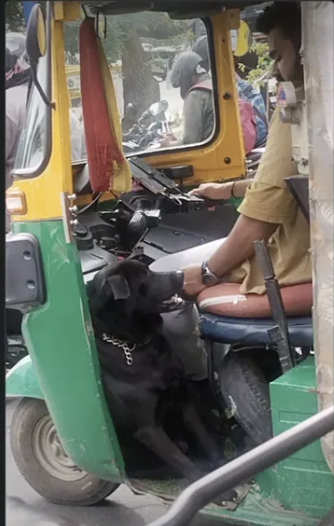
Somewhere in Bengaluru, a black dog has appointed himself co-driver. He rides in the footwell of his human's auto, chin up near the gear stick, going wherever the fares go — and by the look on both of them, neither considers this an arrangement that requires explaining to anybody.
We opened this issue with an auto and a dog, and it was not a happy scene. So here is the same two species, in the same vehicle, on the same city's roads — and the only variable that changed is that somebody decided the dog had a claim.
That's the whole intervention. No shelter, no rescue, no fundraiser. A man who made room.
Via @phd.moments on Instagram — filmed, in the poster's own words, without asking the driver first. We're noting that, because this issue is about asking.
Two findings worth carrying around. Light on pictures, heavy on oh.
It's a subject, not a personality
Stephen Kellert sorted human orientations toward animals into types and named one dominionistic — satisfaction taken from mastery and control. It isn't most people's worldview; it surfaces situationally, wherever a human holds the leverage. And when he tracked children from second grade to eleventh, the scores moved by grade. Which means somebody is teaching it. Nobody in particular. Continuously.
Source · Kellert (1984) →Half of adults can't tell if a cat is happy
A randomised trial showed 368 adults footage of people playing with cats and asked one question: is this cat enjoying this? Accuracy ran from 40% to 100% — a real share of grown adults doing worse than a coin toss on the animal asleep in their own house. One training video moved the number. The skill was never installed. It was also never hard.
Source · Frontiers in Ethology →What's stirring on the streets near you. Small items, real places — send yours in and we'll run them.
Cruelty costs ₹50. Your coffee costs more.
Under Section 11 of the Prevention of Cruelty to Animals Act, a first offence of cruelty carries a fine of ten to fifty rupees. A second offence within three years: twenty-five to a hundred, or up to three months inside.
Those numbers have not been touched since 1960. Sixty-six years. A cappuccino has outrun the entire deterrent.
There is a fix drafted — the PCA (Amendment) Bill, 2022, carrying 61 proposed changes and penalties that would actually register. As of a parliamentary reply on 3 February 2026, it is still "under examination." Not law.
So when a courtroom or a council explains that the street dogs are the ones out of control, hold both facts at once: the animals are managed with round-ups and relocation orders, and the humans who hurt them are managed with a fine you could pay in coins.
— with thanks to @curioustalks, whose work on animal cruelty sent us down this one.
A door that opens at 2 a.m.

Apna Ghar, in Sector 64, has put out an open line for rescuers who get stuck after midnight — the hours when a hit-and-stranded animal has nowhere to go and every clinic is shut.
Charu, who runs it, isn't asking anyone to donate in that message. She's saying the shelter is awake. It belongs in this issue precisely because the gap is so rarely money — it's whether anybody has decided the animal has a claim on their night.
@apna.ghar.by.charu · Sector 64, Gurgaon
Send us the good, the grim, and the local
A shelter that answers after midnight, a school that teaches kids to read a dog, an RWA that got it right, a black-spot where nobody stops. City Notes runs on tip-offs — reply to this issue with what you're seeing.
So — are we doing right by them?
Mull it over · India · 2026 · Read about us · Privacy Policy